
Ipswich, QLD
Self-Employed Home Loans Ipswich
We help self-employed Ipswich borrowers present their income to the right lender and arrange the loan around how that lender reads it.
If you run a business, your tax return is written to minimise assessable income and your loan application needs it to do the opposite. Both things are legitimate. The work is knowing which lender reads your financials most favourably and putting your file in front of that one.
How We Read Self-Employed Income
We assess your financials the way a lender will, work out what your assessable income actually comes to once add-backs are applied, match you to the lender that reads your structure best, and structure the application around it.
Two applicants with identical businesses can get materially different answers depending on which lender assesses them, because add-back treatment, averaging rules and attitudes to company and trust structures vary considerably. Choosing well is most of the value here.
We work with sole traders and tradies, company directors, contractors, and people in their first or second year of business who have been told by a bank that they need to wait.
What Happens After You Contact Us
-
First conversation, about 20 minutes.
Your business, structure, how long you have been running and roughly what the financials look like. Free.
-
Assessable income assessment.
We work through your returns, identify the add-backs and come back with what lenders will actually count and which ones suit you.
-
Lender selection.
We match you to the lender that reads your income and structure most favourably.
-
Application and approval, one to two weeks
for a well-prepared file.
-
Settlement, typically four to six weeks from an accepted offer.
What to have ready
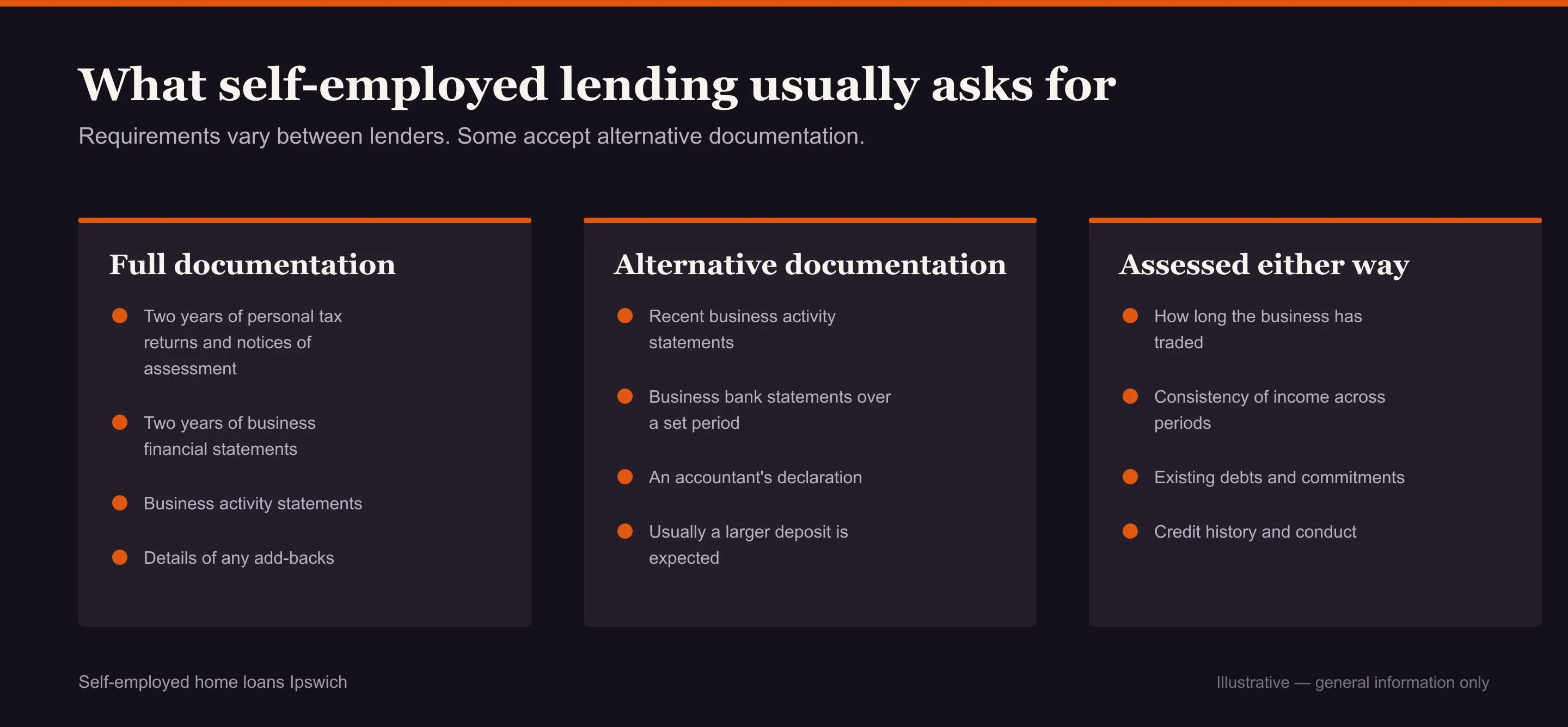
Have your last two years of tax returns and notices of assessment, recent BAS statements, business bank statements, and details of any ATO debt or payment arrangement.
What Happens When You Get in Touch
Tell us where you are up to and we work out what you can borrow, which lenders suit your situation and what the next step looks like. If the answer is that you are better off waiting, we tell you that too.
Our first conversation costs you nothing. On standard residential loans the lender pays us a commission when your loan settles, so there is no fee to you. If an exception ever applied, it would be in writing in our Credit Guide before you committed to anything.
Ask about self-employed home loans
Tell us where you are up to and we will come back the same day with what you can borrow, which schemes you qualify for and what deposit you would need. No cost, and no obligation to go ahead.
Add-Backs and How Lenders Read Your Income
Your net profit is not your assessable income for lending purposes, and understanding the gap is worth real borrowing capacity on an Ipswich purchase.
Add-backs are expenses a lender will put back on top of your net profit because they are not genuine ongoing cash costs to you. Depreciation is the most common. It reduces your taxable income without any money leaving your account. Others include one-off expenses that will not recur, additional superannuation contributions above the required amount, interest on debts being refinanced, and some non-cash items.
The catch is that no two lenders treat them the same way. One will accept a full depreciation add-back, another applies limits, a third wants your accountant to confirm each one in writing. That is why the same set of Ipswich financials produces different borrowing capacity depending on where the file is lodged.
We go through your last two years of returns and identify every legitimate add-back before choosing a lender, then present the file to the one that will count the most of them. That single step is where most of the Ipswich self-employed files we run gain their borrowing capacity.
How the years are combined matters too. Most lenders take the lower of your last two years, or an average, and some will use the most recent year if your income is trending upward. That is a significant difference if last year was your best year.
Buying With One Year of Your Returns
The standard requirement is two years of tax returns plus notices of assessment. Not every lender insists on it.
Some will lend on a single year's returns where your business is established, your income is consistent and the industry is stable. It helps if you were employed in the same field before going out on your own. A tradie who worked for a builder for eight years and started their own business fourteen months ago is a very different risk from a genuine start-up, and the right lender sees that.
This is the decision most people in their second year face: wait for another return, or apply now with the lender that accepts one year. Waiting can mean a better rate and a higher loan-to-value ratio. Applying now means you buy at today's price. We put both options in front of you with what each is likely to cost, rather than telling you to wait as a default.
Low-Doc Options If You Are on the Tools
Where full financials are not available, alt-doc lending assesses your income differently, usually through BAS statements, an accountant's declaration, or business bank statements over a set period.
Be clear about what this is. Low-doc does not mean no-doc, and it never has since responsible lending obligations came in. You still have to evidence your income; you are simply doing it through different documents. Any lender or broker suggesting you can borrow without demonstrating capacity to repay is not operating within the rules.
The trade-off is priced in. Alt-doc loans generally carry a higher rate and a lower maximum loan-to-value ratio, so you need a larger deposit. For someone who has been building an Ipswich business for two years while paying rent, that trade is often worth making. For someone three months from having a clean second return, usually not.
The Ipswich growth corridor has a high concentration of trades and small business, so this is routine work for us rather than an exception we handle occasionally.
If You Have Tax Debt or Late Lodgements
An ATO debt does not automatically stop you. It does narrow the field and it needs handling deliberately.
Lenders differ widely. Some will decline outright on any tax debt. Others accept it where there is a formal ATO payment arrangement in place and you have been meeting it. A few will consider it as an ordinary liability provided your lodgements are current.
What consistently causes problems is being behind on lodgements. Overdue returns make your income unassessable, because a lender cannot verify what has not been filed. If you are behind, getting current with your accountant is the single most useful thing you can do before applying, and it is usually faster than people expect.
Tell us about a tax debt early. It is far easier to place a file correctly from the start than to explain a debt that surfaced during assessment.
Company and Trust Structures
If you operate through a company or a trust, assessment gets more involved and lender variation widens further.
For a company, lenders look at both your personal returns and the company financials, and they differ on how they treat retained profits. Some will count profits retained in the company as available to you; others count only what you have actually drawn as wages or dividends. That distinction alone can move your borrowing capacity a long way.
Trust structures add the question of who receives distributions and whether that pattern is consistent. Discretionary trusts where distributions move around between beneficiaries need explanation, and some lenders are simply not comfortable with them.
We ask about your structure in the first conversation because it narrows the sensible lender list immediately. There is no point comparing twenty lenders when six of them will not read your setup properly.
Self-Employed Home Loans Ipswich Questions
What financials do you need from me?
Your last two years of personal tax returns and notices of assessment, plus company or trust financials if you operate through a structure. Recent BAS statements and business bank statements help.
If you only have one year, bring that. Some lenders will work with it, and we will tell you straight away whether yours is one of those situations.
What does it cost me to use you?
Nothing for the first conversation, and nothing at all on a standard residential loan. The lender pays us a commission when your loan settles, which is how broking works in Australia. That covers the time we spend reading your returns and working out your add-backs.
If a fee ever applied to your situation, we would set it out in writing in our Credit Guide before you decided to go ahead. You would never find out about a cost after the fact.
Can I buy with only one year of tax returns?
Often yes. Two years is the standard requirement, but some lenders accept a single year where the business is established, income is consistent, and you have prior experience in the same industry.
We compare what waiting for a second year would get you against what is available now, so you can decide whether the better terms are worth the delay.
What are add-backs?
Expenses a lender adds back to your net profit because they are not real ongoing cash costs. Depreciation is the main one, along with one-off expenses, extra superannuation contributions and interest on debt being refinanced.
They can lift your assessable income considerably. Because lenders treat them inconsistently, identifying every legitimate add-back and then choosing the lender that accepts the most of them is a large part of what we do on Ipswich self-employed files.
Does an ATO debt stop me getting a loan?
Not necessarily. Some lenders decline on any tax debt, others accept it where you have a formal ATO payment arrangement and have been meeting it.
Overdue lodgements are the bigger obstacle, because a lender cannot assess income you have not declared. Getting current with your accountant is usually the fastest fix, and it is worth doing before we lodge anything with an Ipswich lender.
Talk to a Mortgage Broker in Ipswich
Tell us where you are up to and we work out what you can borrow, which lenders suit your situation and what the next step looks like. If the answer is that you are better off waiting, we tell you that too.
Where We Arrange Self-Employed Home Loans
We work across the whole of Ipswich and the western corridor, from the established streets closer in to the new estates on the edge. Most of what we do happens by phone and email, so where you are inside that footprint does not change how we work or what it costs you.
Mortgage Broker Ipswich
Ipswich, QLD 4305
Monday to Friday, 9am to 5pm
ABN 38 361 529 668