
Ipswich, QLD
First Home Buyer Loans Ipswich
We help Ipswich first home buyers work out which grants and schemes they actually qualify for, then arrange the loan around them. That is the whole job: we check your eligibility against every scheme running right now, stack the ones that combine, and manage the application through to settlement.
If you have read something national and assumed it applies here, it often does not. Occasionally that works in your favour. The federal price cap that applies in Ipswich is higher than the figure quoted for most of Queensland. We check the specifics against your situation before you start inspecting, because those details decide which properties are even in play for you.
How We Help You Buy Your First Home
We do three things. We assess which first-home help you qualify for, we stack the schemes that legally combine, and we arrange and manage the loan itself: lender selection, application, and the paperwork through to settlement.
The eligibility work matters more here than the loan comparison, because Queensland runs several schemes with different rules and they interact. Getting the order and the timing right changes how much deposit you need and what you can afford to buy. That is what we are checking in the first conversation.
You might be at any of three points: still saving and wanting to know if you are close, standing in front of a place you need to move fast on, or holding a bank answer that says you cannot borrow enough. All three are worth a conversation.
What Happens After You Contact Us
The process is the same every time and there are no surprises in it.
-
First conversation, about 20 minutes.
You tell us where you are up to, what you earn and what you have saved. We tell you roughly where you stand. This is free and there is no obligation attached to it.
-
Eligibility and scheme map.
We come back with which schemes you qualify for, which ones combine, and what each is worth to you in dollars.
-
Borrowing capacity.
We work out what you can actually borrow under current lending rules, which is usually different from what an online calculator told you.
-
Pre-approval, typically one to two weeks.
We lodge with the lender that best fits your situation. You go house hunting knowing your real number.
-
Settlement, usually four to six weeks from an accepted offer.
We manage the lender, chase the valuation and coordinate with your conveyancer.
What to have ready
Have your ID, recent payslips, savings history, and a list of your debts and credit card limits ready before the first call and we can move considerably faster.
What Happens When You Get in Touch
Tell us where you are up to and we work out what you can borrow, which lenders suit your situation and what the next step looks like. If the answer is that you are better off waiting, we tell you that too.
Our first conversation costs you nothing. On standard residential loans the lender pays us a commission when your loan settles, so there is no fee to you. If an exception ever applied, it would be in writing in our Credit Guide before you committed to anything.
Ask about first home buyer loans
Tell us where you are up to and we will come back the same day with what you can borrow, which schemes you qualify for and what deposit you would need. No cost, and no obligation to go ahead.
Which First-Home Help You Qualify For
There are four separate things you might be eligible for, and they are not the same as each other. We work through all of them against your income, your deposit and the type of property you are looking at.
The Queensland First Home Owner Grant is $30,000, but only on a new home valued under $750,000 including the land. Established homes do not attract it at all. If you are building, that $30,000 is real money we plan the contract timing around. You need to move in within twelve months and live there for six continuous months, though you may rent out a room during that period. If you are buying established, we tell you upfront that this one is not available to you rather than letting you find out later.
Transfer duty is the second. Since 1 May 2025 there is no transfer duty at all on a new home or on vacant land you are building on, and there is no value cap on that concession. That is worth thousands and it applies at any price point, which is why building can work out cheaper than the sticker price suggests. On an established home you get the first home concession instead: a full exemption up to $700,000, phasing out to $800,000. That is the one that matters in Goodna and Booval, where established stock dominates and almost nothing new gets built.
The third is the First Home Guarantee, and this is where Ipswich buyers are most often misinformed. See the section below.
The fourth is Queensland's Boost to Buy shared equity scheme. It runs on a 2% deposit with the government taking an equity share of up to 30% on a new home or 25% on an existing one, capped at a $1,000,000 property, with income caps of $155,000 for a single buyer and $232,000 for two adults or a single buyer with dependants. The approved lender is Unity Bank. The catch for you is that South East Queensland allocations were reported exhausted at the most recent Treasury update, so it may not be open to an Ipswich buyer at all right now. We check the live round status before we ever build a plan around it.
Which First-Home Schemes You Qualify For
Ipswich postcode 4305 sits inside the Greater Brisbane statistical area, so the First Home Guarantee price cap here is $1,000,000, not the $700,000 rest-of-state figure you will see quoted for regional Queensland. That is a significant difference and it puts a large part of the local market within reach of a 5% deposit.
Under the guarantee you buy with a genuine 5% deposit and pay no lenders mortgage insurance, because the government guarantees up to 15% of the loan. Since 1 October 2025 there are no income caps and no limit on places. We place you with a participating lender and structure the application around the scheme rules.
Some suburbs span more than one postcode, so we confirm your specific address against the official tool before you rely on the cap. It is a two-minute check that avoids a very expensive assumption.
The grant, the nil duty on a new build and the First Home Guarantee can generally be combined. The federal Help to Buy scheme and the First Home Guarantee cannot be used together, and Boost to Buy runs through its own approved-lender pathway. We map which combination gives you the best outcome rather than applying for whichever one you heard about first.
Buying New vs Established: What Changes
This is the single biggest decision in front of you and it is not really about the house. It changes which schemes you get.
Build or buy new and you are looking at the $30,000 grant plus nil transfer duty with no value cap. Buy established and you get neither the grant nor the uncapped duty concession, though the established first home concession still removes duty entirely up to $700,000.
That is why so many local first home buyers end up out in the Ripley growth corridor rather than the older suburbs. Building is the default path here, not the exception. We are not pushing you toward a new build. We tell you what each option is worth in dollars, so you can weigh that against the fact an established home in Booval comes with a grown garden and a shorter commute.
If you do decide to build, the finance works differently and we cover that separately on our construction loans page.
Getting Your Deposit and Pre-Approval Ready
A few things quietly decide how much you can borrow, and most of them are fixable before you apply rather than after.
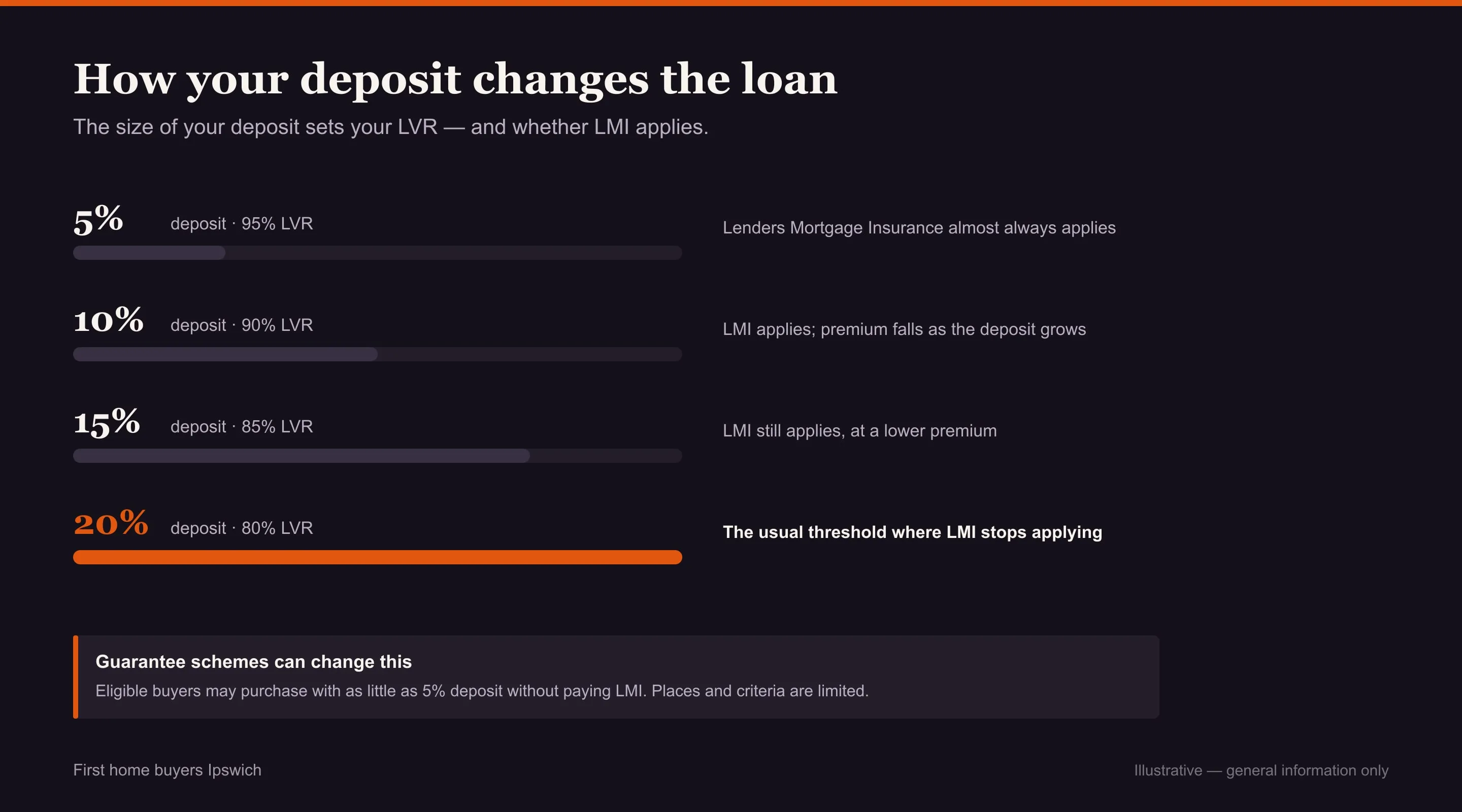
Lenders mortgage insurance generally kicks in once you are borrowing more than 80% of the property value. The First Home Guarantee is one way around it. A family security guarantee is another. Saving to a 20% deposit is a third, and sometimes waiting is genuinely the wrong answer, because prices move faster than your savings do. We model the three side by side so you are choosing rather than guessing.
Most lenders want to see genuine savings, meaning money you accumulated yourself rather than a lump sum that appeared last week. If your deposit is partly a gift, that is workable, but it changes which lenders will look at you and we need to know early.
Your existing debts matter more than people expect, and we go through them before anything is lodged rather than letting a lender find them.
First Home Buyer Loans Ipswich Questions
What do you need from me to get started?
Photo ID, your last few payslips, three to six months of savings history, and a list of your current debts including credit card limits. If you have found a property, the contract or listing helps too.
You do not need all of it for the first conversation. We can give you a useful answer from your income, your deposit and whether you are looking at new or established.
What does it cost me to use you?
Nothing for the first conversation, and nothing at all on a standard residential loan. The lender pays us a commission when your loan settles, which is how broking works in Australia. Checking which schemes you qualify for costs you nothing, whether or not you end up qualifying.
If a fee ever applied to your situation, we would set it out in writing in our Credit Guide before you decided to go ahead. You would never find out about a cost after the fact.
What if I turn out not to be eligible for anything yet?
Then we tell you, and we map what would change it. Usually it comes down to deposit size, a debt or card limit that needs clearing, or a timing issue with a scheme round.
We put a rough timeline on it so you know whether you are three months away or eighteen. Plenty of people we speak to are closer than they think, and a few are further away than they hoped. Both are worth knowing now rather than after a declined application.
Can I get the $30,000 grant on an established home?
No. The Queensland First Home Owner Grant applies only to new homes valued under $750,000 including the land. An established home does not qualify, no matter how much work it needs.
If you are set on an established property, the first home transfer duty concession is still worth having: full exemption to $700,000, phasing out at $800,000.
Which First Home Guarantee price cap applies in Ipswich?
The $1,000,000 cap. Ipswich sits inside the Greater Brisbane statistical area, so it takes the capital city figure rather than the $700,000 cap that applies to the rest of Queensland.
Because some suburbs span multiple postcodes, we confirm your specific address against the official tool before you rely on it.
Can I combine the grant, nil transfer duty and the 5% guarantee?
Generally yes. Those three are designed to work together, and on a new build in Ipswich that combination is the strongest outcome available to most first home buyers.
The exceptions matter: Help to Buy and the First Home Guarantee cannot be combined, and Boost to Buy runs through its own approved lender. We check which combination is open to you before anything is lodged.
Talk to a Mortgage Broker in Ipswich
Tell us where you are up to and we work out what you can borrow, which lenders suit your situation and what the next step looks like. If the answer is that you are better off waiting, we tell you that too.
Where We Arrange First Home Buyer Loans
We work across the whole of Ipswich and the western corridor, from the established streets closer in to the new estates on the edge. Most of what we do happens by phone and email, so where you are inside that footprint does not change how we work or what it costs you.
Mortgage Broker Ipswich
Ipswich, QLD 4305
Monday to Friday, 9am to 5pm
ABN 38 361 529 668