
Ipswich, QLD
Refinancing Ipswich
We review your current Ipswich home loan, compare it against what is available across our lender panel and, if the switch is genuinely worth making, manage the whole change for you.
Sometimes the honest answer is that you should stay where you are. Break costs, a lenders mortgage insurance re-trigger or a serviceability problem can wipe out a rate saving entirely. We do the sums before you move, and we show you the ones that argue against switching as well as the ones that argue for it.
How Our Refinance Review Works
We do three things. We review what you are currently paying and what it is costing you, we compare that against the market, and if you are better off moving we manage the application, the discharge from your existing lender and the settlement.
The review itself is the valuable part and it is free. Plenty of the reviews we run end with us telling you to stay put, usually because a fixed rate has time to run, or because the costs of moving exceed the benefit over any realistic timeframe.
You might be coming to this because a fixed term is ending, because a rate change landed and yours now looks high, because you want to pull equity out for a renovation or an investment, or because you are carrying credit card and personal loan debt you want to deal with.
What Happens After You Contact Us
-
Send us your loan details.
Your current lender, rate, balance and whether you are fixed or variable. A recent statement covers most of it.
-
Benefit comparison.
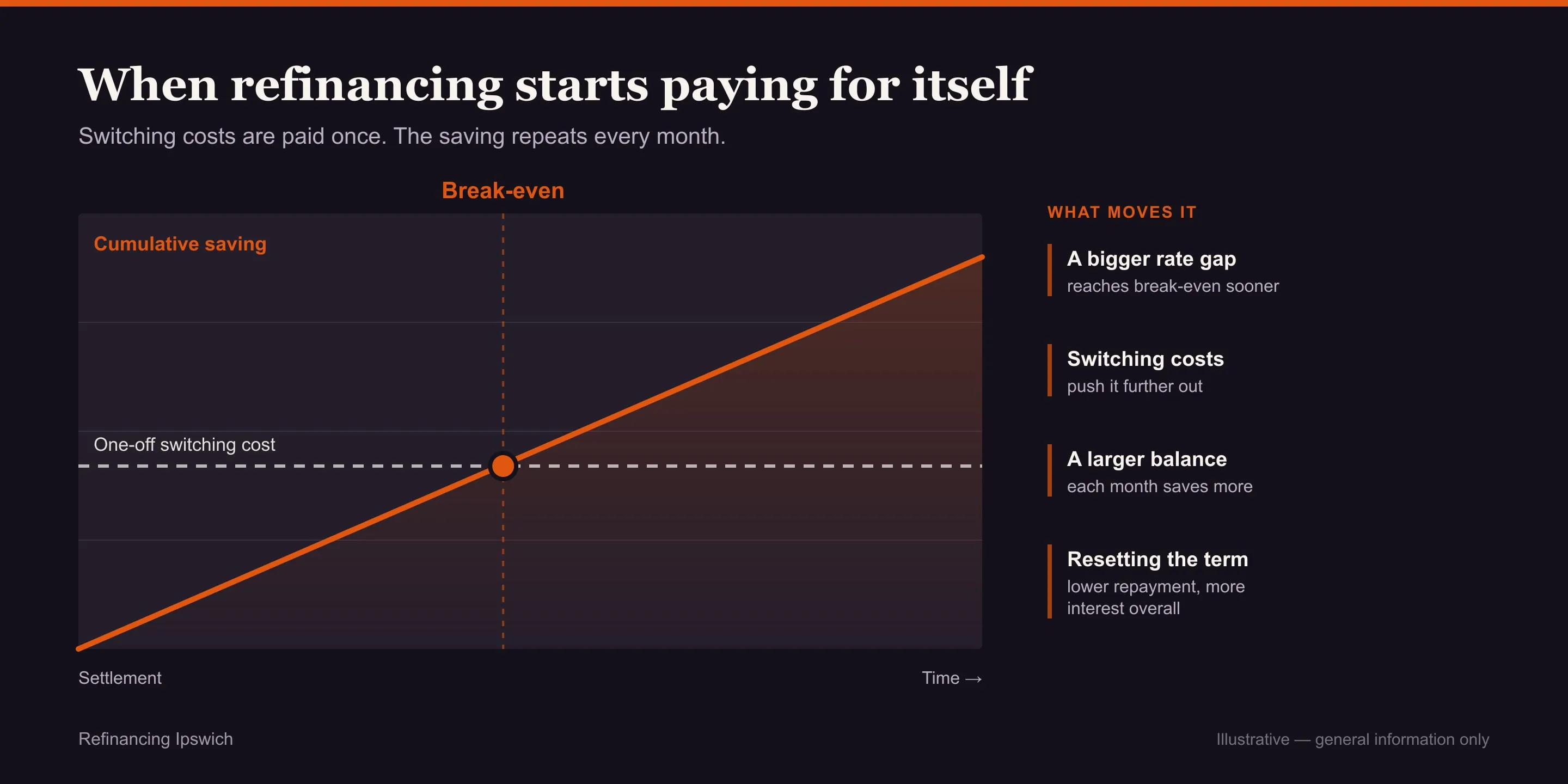
We come back with what is available, what the switch costs, and the break-even point. Including the case for staying put if that is where the numbers land.
-
Application, if you go ahead.
One to two weeks to approval for a straightforward file.
-
Discharge and settlement, typically three to six weeks.
We coordinate the discharge with your outgoing lender, which is the part that most often runs slow, and we chase it.
What to have ready
Have a recent loan statement, your last two payslips or income evidence, and a list of any other debts ready.
What Happens When You Get in Touch
Tell us where you are up to and we work out what you can borrow, which lenders suit your situation and what the next step looks like. If the answer is that you are better off waiting, we tell you that too.
Our first conversation costs you nothing. On standard residential loans the lender pays us a commission when your loan settles, so there is no fee to you. If an exception ever applied, it would be in writing in our Credit Guide before you committed to anything.
Ask about refinancing
Tell us where you are up to and we will come back the same day with what you can borrow, which schemes you qualify for and what deposit you would need. No cost, and no obligation to go ahead.
What a Switch Actually Costs You
A lower rate is only half the calculation. Here is the other half, and we put real numbers against each of these before recommending anything.
Break costs on a fixed loan. If you are still inside a fixed term on your Ipswich loan, exiting early triggers a break fee that is calculated on the lender's funding position rather than a set schedule. It can be trivial or it can be very large, and there is no way to know without asking your lender for a figure. We get it in writing from your lender before we go any further.
Discharge and settlement fees. Your existing Ipswich lender charges to release the mortgage, and the incoming one has its own establishment costs. Individually small, collectively enough to change a marginal decision.
Lenders mortgage insurance, again. This is the one people do not see coming. LMI is not portable, so you cannot take it with you. If you are refinancing at above 80% of the current valuation, the new lender can charge it again even though you already paid it once on the original loan. We check your loan-to-value ratio against a current Ipswich valuation estimate before we go anywhere near an application.
When we come back to you, it is with the saving on one side and every one of those costs on the other, plus how long it takes to break even on your Ipswich loan.
When a Refinance Gets Blocked
This one catches you out even if you have never missed a payment.
When you refinance, the new lender reassesses your serviceability from scratch, at your actual rate plus the three percentage point buffer. If your circumstances have changed since you took the loan out, or if rates have risen since, you can fail that assessment on a loan with lower repayments than the one you are already comfortably paying. It is a genuinely perverse outcome and it has trapped a lot of borrowers.
There is a way through it. Some lenders apply a reduced buffer on a like-for-like refinance where you are not borrowing more and the term is not extending. Not all of them do, and the ones that do change their position periodically. We know who is currently offering it and we place your application there rather than burning a credit enquiry finding out.
If nothing works right now, we tell you that plainly and set out what would need to change.
Releasing Equity from Your Home
If your property has grown in value, refinancing can release some of that equity as cash. Established Ipswich suburbs have seen strong growth, and using that equity as the deposit on a first investment property is one of the most common reasons people call us.
Lenders require a stated and evidenced purpose for cash out. Renovation, an Ipswich investment deposit, a business purpose: all fine, and all needing documentation. Vague answers slow the application down or get it declined.
Two limits worth knowing before you plan around it. Pulling equity out increases your loan-to-value ratio, and going above 80% brings LMI back into play. Larger cash-out amounts also attract more scrutiny and some lenders cap what they will release without a full application for the end purpose.
We work out how much your Ipswich property can realistically release and what it does to your repayments before you start making plans for the money.
Should You Consolidate Debt Into Your Mortgage?
Rolling credit cards, a car loan or a personal loan into your mortgage lowers your monthly repayment, sometimes dramatically. That is real and it can be the right call.
But it is not automatically cheaper, and we are required to show you why. You are moving short-term debt onto a twenty-five or thirty-year term. A car loan with three years left, absorbed into a mortgage and paid over the remaining term, can cost you more in total interest than leaving it alone, even at a much lower rate. The monthly number improves. The lifetime number can get worse.
So we model both. Repayment now, and total cost over the life of the debt. If consolidating genuinely helps, the numbers show it. If the honest answer is that it only helps your cash flow this month at real long-term cost, the numbers show that too and you decide with the full picture.
One structure that often works better: consolidate, but keep making the same total repayment you were making before. You get the cash flow safety net without the extended term, and you can drop back if things get tight.
Fixed vs Variable on Your New Loan
Refinancing is a natural moment to reconsider this, and the answer that suited you five years ago may not suit you now.
Fixing locks your repayment and protects a tight budget, at the cost of flexibility: restricted extra repayments, usually no full offset, and a break cost if you move again or sell.
Variable keeps the door open, which matters if there is any chance you will sell, renovate or refinance again within a few years.
If you are refinancing partly to consolidate debt, we usually lean toward keeping enough of the loan variable that you can attack the consolidated portion with extra repayments. Fixing the lot removes the mechanism that makes consolidation work.
Refinancing Ipswich Questions
What do you need to review my loan?
A recent statement showing your lender, balance, rate and loan type. That alone tells us most of what we need for a first look.
To take it further we need your income evidence and a list of your other debts, because a refinance is a full reassessment rather than a rate negotiation.
Does a loan review cost me anything?
No. The review is free and it comes with no obligation to switch. A decent proportion of them end with us recommending you stay where you are.
If you do refinance, the lender pays us a commission on settlement. There is no fee to you on a standard residential refinance.
Will refinancing above 80% cost me LMI again?
It can, yes. Lenders mortgage insurance is not portable between lenders, so if your new loan is above 80% of the current valuation, the incoming lender can charge it again even though you paid it on the original loan.
We check your loan-to-value ratio against a current valuation before applying. If you are close to the line, waiting or making a lump sum repayment first can save you thousands.
Can the 3% buffer stop me refinancing to a lower rate?
It can, and it is more common than you would think. The new lender assesses you at the new rate plus three percentage points, so you can fail on a loan with lower repayments than the one you are currently paying without difficulty.
Some lenders apply a reduced buffer on like-for-like refinances where you are not borrowing more. We know which ones currently do and we lodge there rather than testing the market with your credit file.
Is consolidating debt into my mortgage actually cheaper?
Your monthly repayment almost always drops. Whether you pay less in total depends on the term, and often you pay more. A three-year car loan stretched across twenty-five years can cost more overall even at a much lower rate.
We show you both figures before you decide. If it works for you, it works. We are not going to present it as a straightforward win when the arithmetic says otherwise.
Talk to a Mortgage Broker in Ipswich
Tell us where you are up to and we work out what you can borrow, which lenders suit your situation and what the next step looks like. If the answer is that you are better off waiting, we tell you that too.
Where We Arrange Refinancing
We work across the whole of Ipswich and the western corridor, from the established streets closer in to the new estates on the edge. Most of what we do happens by phone and email, so where you are inside that footprint does not change how we work or what it costs you.
Mortgage Broker Ipswich
Ipswich, QLD 4305
Monday to Friday, 9am to 5pm
ABN 38 361 529 668