
Ipswich, QLD
Home Loans Ipswich
We arrange home loans for Ipswich buyers and owners: comparing lenders across our panel, working out what you can genuinely borrow under current rules, and managing the application end to end.
The number an online calculator gives you and the number a lender will actually approve are usually different, and the gap has widened over the last few years. That gap decides which home loans Ipswich buyers can realistically go after, so we would rather show you the real figure in the first conversation than let you find it out after an offer has been accepted.
What We Do on a Home Loan
We compare the lenders on our panel against your situation, get you pre-approved with the one that fits best, and manage the application through valuation, formal approval and settlement.
Where we earn our keep is in the assessment rules. Lenders do not all read income, debts or property the same way, and the difference between the most and least generous can be a hundred thousand dollars of borrowing power on identical financials. We know which is which and we place you accordingly.
You might be buying your next home, holding a bank number that seems too low, or wanting a pre-approval before you start looking. All three start with the same conversation.
What Happens After You Contact Us
-
First conversation, about 20 minutes.
Income, deposit, debts, what you are looking at. Free, no obligation.
-
Borrowing capacity.
We come back with what you can borrow across the relevant lenders and where the differences sit.
-
Pre-approval, one to two weeks.
We lodge with the lender that suits you and manage the assessment.
-
Offer and formal approval.
Once you have a contract, we order the valuation and push the file through.
-
Settlement, typically four to six weeks from an accepted offer.
We coordinate with your conveyancer and the lender.
What to have ready
Bring payslips, your last two years\' income evidence if it is not salaried, a list of debts and card limits, and recent statements for your everyday accounts.
What Happens When You Get in Touch
Tell us where you are up to and we work out what you can borrow, which lenders suit your situation and what the next step looks like. If the answer is that you are better off waiting, we tell you that too.
Our first conversation costs you nothing. On standard residential loans the lender pays us a commission when your loan settles, so there is no fee to you. If an exception ever applied, it would be in writing in our Credit Guide before you committed to anything.
Ask about home loans
Tell us where you are up to and we will come back the same day with what you can borrow, which schemes you qualify for and what deposit you would need. No cost, and no obligation to go ahead.
What You Can Actually Borrow
Three rules set your ceiling, and none of them are obvious from the outside.
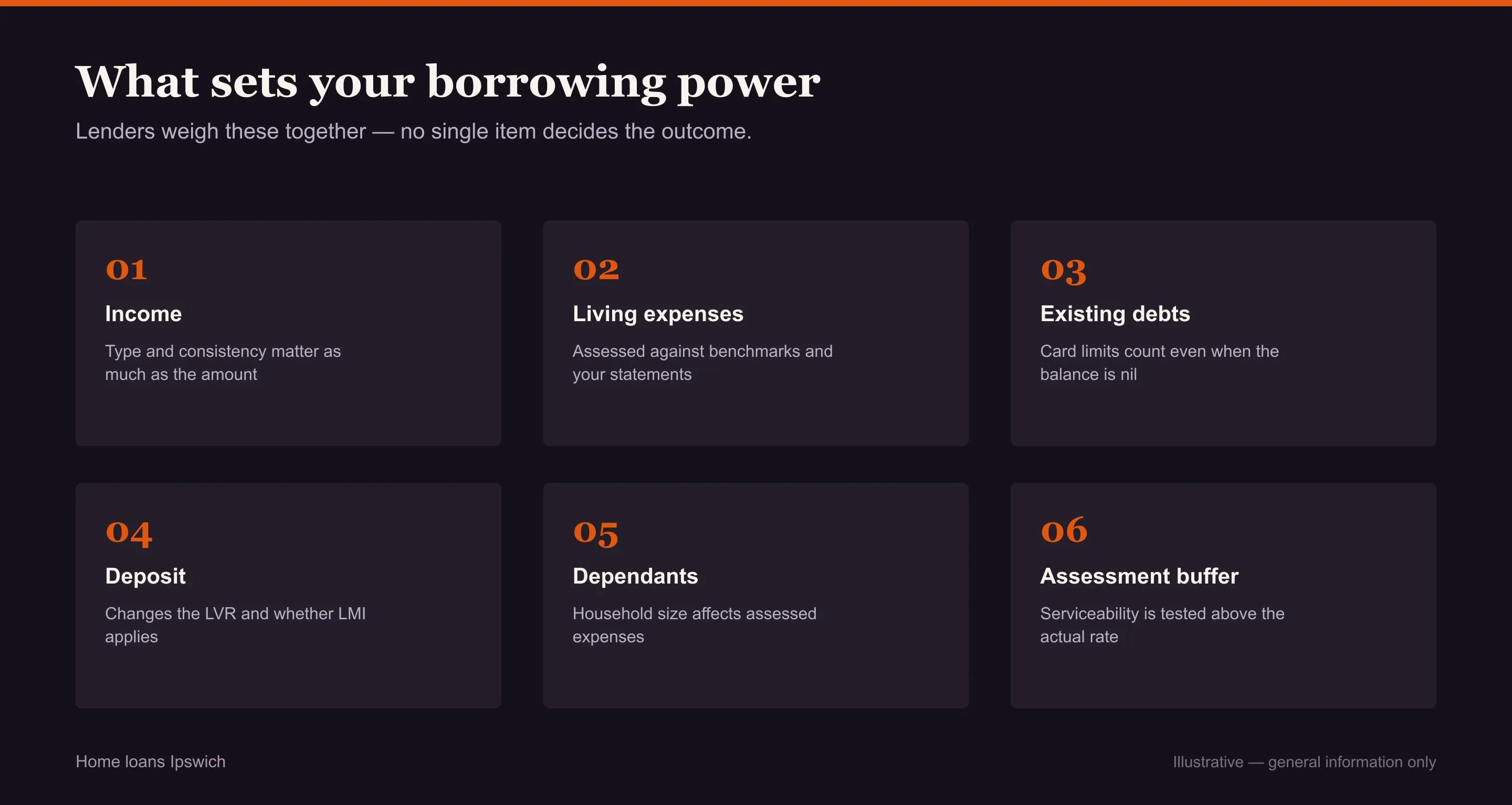
The first is the APRA serviceability buffer. Every lender must assess you at your actual rate plus three percentage points, a rule unchanged since October 2021 and explicitly held in place at APRA's macroprudential update on 11 June 2026. So your approval is calculated against repayments considerably higher than the ones you will actually make. This is the main reason you can borrow less than your income suggests, and it is also why lender choice matters. The buffer is fixed, but everything around it is not.
The second is your credit card limits. Lenders count the limit, not the balance. A card with a $20,000 limit and nothing owing on it still reduces your borrowing capacity as though you owed the lot. We go through your limits before anything is lodged and reduce or close what you are not using, because it is one of the few levers you can pull in a fortnight.
The third is lenders mortgage insurance, which generally applies once you are borrowing above 80% of the property value. It can run to thousands of dollars. We model paying it now against saving to 20% against using a family security guarantee, so you can see what each option costs you rather than defaulting to whichever one you heard of first.
Lenders also apply a benchmark for household living expenses, so declaring a very low spend does not lift your capacity the way you might expect. The benchmark takes no account of Ipswich living costs sitting below Brisbane.
One more rule shapes what lenders will do. From February 2026, APRA requires lenders to keep new loans at a debt-to-income ratio of six or above to no more than 20% of their new lending. That is a limit on the lender's book rather than a ban on you, but it does mean high-DTI applications get tighter treatment and lender appetite varies month to month. We know which lenders currently have room, and we lodge with the ones that do.
Getting Pre-Approved
Pre-approval tells you your real number and makes your offer credible to an Ipswich agent. It typically takes one to two weeks from a complete application.
It runs for a set period, usually around three months, and it can be extended. We diarise the expiry so it does not lapse the week you find something.
One risk worth knowing about: pre-approval is based on your finances, not on a specific property. If the lender's valuation comes in below the price you agreed, the shortfall comes out of your deposit. The lender calculates its lending against the valuation, not the contract. Valuations across Ipswich have been moving quickly enough that this is worth watching, so we flag properties where it is a live risk before you make an offer.
Fixed vs Variable: How We Help You Choose
There is no universally correct answer here and anyone who tells you otherwise is selling something. What we do is work out which risk you would rather carry.
Fixing buys certainty. Your repayment does not move for the term, which matters if your budget has no slack in it. The trade-off is that fixed loans usually restrict extra repayments, rarely come with a full offset account, and cost you a break fee if you exit early. That includes selling.
Variable keeps your options open. You can make extra repayments, use an offset properly, and refinance without a break cost. You carry the movement.
A split is common and is not a fudge. Fixing part of the loan protects your baseline while the variable portion stays flexible. We size the split around your actual budget rather than picking a round number.
Offset and Redraw for Your Situation
These two get treated as the same thing and they are not.
An offset is a transaction account linked to your loan. Money in it reduces the balance interest is charged on, but it stays your money in your account. You can spend it tomorrow without asking anyone.
Redraw is different. Extra repayments go onto the loan, and you apply to get them back. Lenders can restrict redraw, change the terms, or reduce your available balance. It is generally the cheaper of the two, and for some borrowers that is the right trade.
If you have a decent cash buffer or you are self-employed with lumpy income, offset usually wins. If you are salaried and disciplined, redraw can be perfectly adequate and cost you less. We ask about how you actually handle money before recommending either.
Buying Before You Sell
If you have found your next home while still owning the current one, bridging finance covers the gap. The lender funds the new purchase while the old property is on the market, and you generally pay interest only on the bridging portion until the sale settles.
It works well when your existing home has real equity and will sell reasonably quickly. It gets uncomfortable when the sale takes longer than expected, so lenders set a bridging term and we build the plan around a realistic selling window rather than an optimistic one. Ipswich has been selling quickly, but we plan on the assumption that yours might not.
We work out whether bridging or a longer settlement is the cleaner path for your Ipswich move. Sometimes the answer is simply to negotiate a later settlement date and skip the extra loan altogether.
Home Loans Ipswich Questions
How long does pre-approval take, and what do you need?
Usually one to two weeks from a complete application. Some lenders are faster, and a straightforward salaried application with clean statements moves quickest.
We need photo ID, recent payslips, a list of your debts and credit card limits, and a few months of bank statements. If your income is not salaried, we need your last two years of returns as well.
What does it cost me to use you?
Nothing for the first conversation, and nothing at all on a standard residential loan. The lender pays us a commission when it settles, which is how broking works in Australia. That holds whether you are buying your first Ipswich home or refinancing one you have owned for a decade.
If a fee ever applied to your situation, we would set it out in writing in our Credit Guide before you decided to go ahead. You would never find out about a cost after the fact.
What is the difference between an offset and redraw?
An offset is your own money sitting in a linked account, reducing the interest charged on your Ipswich loan while staying available to spend. Redraw is money you have already paid onto the loan that you apply to get back.
Offset gives you control; redraw is usually cheaper. Which one suits you depends on how much cash you keep on hand and how predictable your income is.
Why does the 3% buffer cut how much I can borrow?
Because the lender does not assess you at the rate you will pay. Regulation requires them to test whether you could still afford the repayments if your rate rose by three percentage points, so the repayment they run through the calculation is materially higher than your real one.
It has been in place since October 2021 and APRA confirmed on 11 June 2026 that it stays. You cannot get around it, but lenders differ in how they treat your income and expenses within it, which is where lender choice earns its money.
Does a credit card limit matter if the balance is zero?
Yes, and this catches people out constantly. Lenders assess the limit as though it were drawn, because you could draw it tomorrow.
If you are carrying limits you do not use, reducing or closing them before we lodge can lift your borrowing capacity noticeably, often by more than the deposit you would save in a year. It is one of the quickest wins available and we check it every time.
Talk to a Mortgage Broker in Ipswich
Tell us where you are up to and we work out what you can borrow, which lenders suit your situation and what the next step looks like. If the answer is that you are better off waiting, we tell you that too.
Where We Arrange Home Loans
We work across the whole of Ipswich and the western corridor, from the established streets closer in to the new estates on the edge. Most of what we do happens by phone and email, so where you are inside that footprint does not change how we work or what it costs you.
Mortgage Broker Ipswich
Ipswich, QLD 4305
Monday to Friday, 9am to 5pm
ABN 38 361 529 668