
Ipswich, QLD
Investment Loans Ipswich
We arrange investment property loans for Ipswich buyers and structure them around the two things that decide whether the deal works: how much rent the lender will count, and whether it will lend on the property at all.
Ipswich yields look strong on paper. The gap between what a spreadsheet says you can afford and what a lender will approve is where most investment plans come unstuck, and closing that gap is the job.
How We Structure Your Investment Loan
We size your real borrowing capacity, structure the loan around your holding strategy, and select lenders based on how they treat rental income and the specific property you are buying.
Lender selection carries more weight on an investment file than almost anywhere else. Two lenders looking at identical financials and the same property can land a long way apart, because they shade rent differently, treat existing portfolio debt differently, and have entirely different appetites for the kind of stock Ipswich has.
You might be buying your first investment, adding to a portfolio that has stopped growing because serviceability has run out, or holding a specific property you want checked before you offer.
What Happens After You Contact Us
-
First conversation, about 20 minutes.
Your goals, existing portfolio, income and what you are considering. Free.
-
Capacity and structure.
We come back with what you can borrow for the next purchase, how to structure it and which lenders fit.
-
Property check, before you offer.
Send us the address and we check flood mapping and lender appetite against it.
-
Pre-approval, one to two weeks.
-
Settlement, typically four to six weeks from an accepted offer.
What to have ready
Have your income evidence, statements for any existing investment loans, and current rental income for anything you already own.
What Happens When You Get in Touch
Tell us where you are up to and we work out what you can borrow, which lenders suit your situation and what the next step looks like. If the answer is that you are better off waiting, we tell you that too.
Our first conversation costs you nothing. On standard residential loans the lender pays us a commission when your loan settles, so there is no fee to you. If an exception ever applied, it would be in writing in our Credit Guide before you committed to anything.
Ask about investment loans
Tell us where you are up to and we will come back the same day with what you can borrow, which schemes you qualify for and what deposit you would need. No cost, and no obligation to go ahead.
How Much of Your Rent Lenders Count
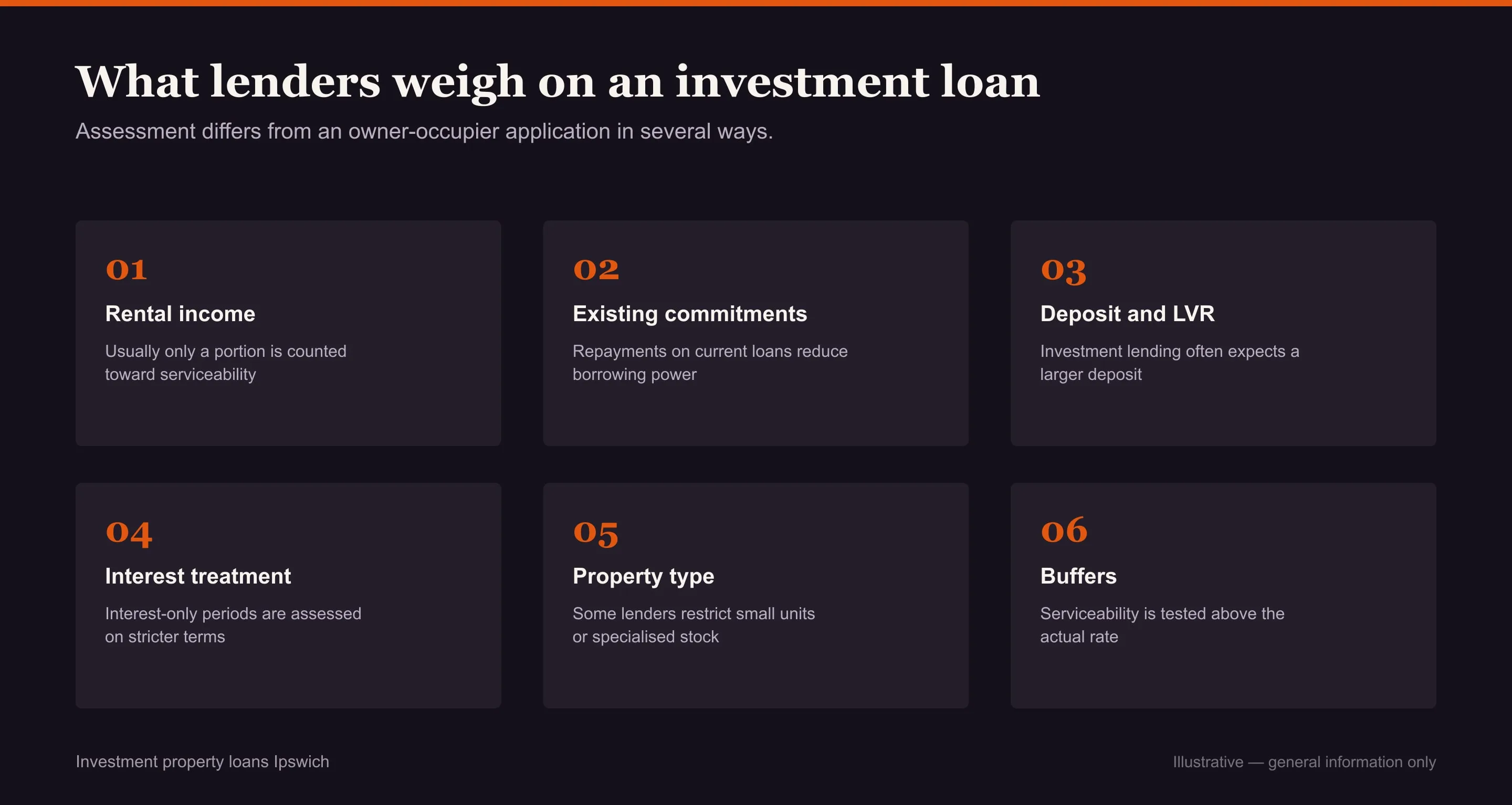
Not all of it. Lenders "shade" rental income, commonly counting around 80% of the gross rent, with the exact figure varying by lender.
The shading covers vacancy, management fees, rates, insurance and maintenance: the costs that sit between gross rent and what actually lands in your account. It is a reasonable adjustment in principle. In practice it means your borrowing capacity is materially lower than a gross yield calculation suggests, and it is the single most common reason an investment plan falls short of approval.
Since the shading percentage moves by lender, so does your capacity. We work out which lenders on our panel shade least against your particular income mix and put your application in front of them.
Two other rules compress capacity further. Interest-only loans are assessed on what the principal and interest repayment would be over the remaining term after the interest-only period ends. So a five-year interest-only period on a thirty-year loan is assessed over twenty-five years, at a higher repayment than you will actually make. And negative gearing benefits are treated differently across lenders; some count the tax benefit in serviceability and some ignore it entirely.
How Flood Zoning Changes Your Options
This is the check that matters most here and the one most investors skip until it is too late.
Ipswich sits across the Bremer and Brisbane River catchments, and the 2011 and 2022 events are recent enough to shape how lenders behave. Their responses vary: some decline flood-exposed property outright, some reduce the maximum they will lend against it, some add a margin to the serviceability assessment, and some will lend but require flood insurance as a settlement condition.
Two things to understand about how this actually works. Treatment is valuer-driven, not postcode-driven. It is generally triggered when the valuer flags flood risk on the specific property, so it runs street by street rather than as a blanket rule. And a flood insurance requirement is the lender's contract policy, not Australian law. There is no national flood insurance programme here.
A conservative valuation on a flood-exposed property is the expensive outcome. The lender calculates its lending against the valuation, so a valuation below contract price means you fund the difference in cash.
So before you offer, we check the address against Ipswich City Council flood mapping. The City Plan 2025 interactive map carries the OV12 Flood Risk and Overland Flow overlay, and the Historical Flood Information Map shows the 1974, 2011 and 2022 extents. Where it is marginal we recommend paying for the Council property report. And we tell you to get an insurance quote before you sign a contract, because a high premium does not just cost you annually. It reduces your borrowing capacity through the serviceability assessment.
We check lender appetite against the specific Ipswich address at the same time. It is a day of work that has saved clients a failed settlement more than once.
Interest-Only vs Principal & Interest for Investors
Interest-only improves cash flow now and costs more later. That is the whole trade.
It keeps repayments down during the interest-only period, which supports holding a negatively geared property, and keeps the deductible interest portion high. When the period ends you repay the full principal over a shorter remaining term, so the step up in repayment is significant and not always well anticipated.
The serviceability catch is worth repeating: because the lender assesses interest-only on the higher post-period repayment, choosing interest-only can reduce how much you are approved for, even though it lowers what you actually pay. Investors are regularly surprised by this.
Principal and interest builds equity from day one and generally assesses more favourably. If you are planning to use this property's equity for the next purchase, that matters.
We work it through against your holding period and your tax position rather than defaulting to interest-only because that is what investors are assumed to want.
Growing Your Portfolio Past the Serviceability Wall
Most investors hit a wall somewhere between the second and fourth property. It is rarely deposit. It is serviceability.
One regulatory change makes it steeper. From February 2026, lenders must keep new loans at a debt-to-income ratio of six or above to no more than 20% of their new lending. That is a cap on the lender's book, not a personal ban on you, but portfolio investors sit at the high end of the DTI range by definition, so appetite tightens and it moves around from quarter to quarter as lenders manage their limits.
What we do about it is sequence. Which lender for which purchase, and in which order, so you are not spending your most generous lender on a purchase that a stricter one would have handled. Doing that well can be worth an extra property.
It also means keeping some lenders in reserve. Consolidating everything with one lender feels tidy and quietly caps your growth.
Yield-Led Buying and What It Costs You
Redbank Plains and Bundamba run higher gross yields than most of metropolitan Brisbane. That is the reason a lot of investors look at Ipswich rather than closer in.
Higher Ipswich yields help you service the loan, but only after the lender has shaded them. A property that looks comfortably self-supporting on gross rent can still leave you short once around 20% has come off the top and the assessment rate is applied. We run your numbers through the shading before you get attached to a place.
Higher-yield Ipswich stock also tends to sit in the areas where flood and valuation issues cluster. That is not a reason to avoid it, but it is a reason to do the checks in the section above before you offer rather than after.
House versus unit shifts the balance too. Houses carry more land value and generally better long-term growth. Units usually deliver higher immediate yield, with body corporate costs against them. Some lenders also restrict lending on smaller units, which narrows the field on Ipswich unit stock in particular.
Investment Loans Ipswich Questions
What do you need to assess my next investment loan?
Your income evidence, statements for your existing loans, and the current rent on anything you already own. If you have a property in mind, the listing and address as well.
If you own several properties, a simple list of each with its value, loan balance and rent is the fastest way to a useful answer.
What does it cost me to use you?
Nothing for the first conversation, and nothing at all on a standard residential investment loan. The lender pays us a commission when your loan settles, which is how broking works in Australia. That covers the flood and valuation checks we run on an Ipswich address before you offer.
If a fee ever applied to your situation, we would set it out in writing in our Credit Guide before you decided to go ahead. You would never find out about a cost after the fact.
How much of my rental income do lenders count?
Commonly around 80% of gross rent, though the exact figure varies by lender. The shading is meant to cover vacancy, management fees, rates, insurance and maintenance.
It is why your capacity comes in lower than a gross yield calculation suggests. Because lenders differ, part of our job is finding the one that shades least on your particular file.
Does the DTI cap affect me personally?
Not as a personal rule. From February 2026, lenders must keep new lending at a debt-to-income ratio of six or above to 20% of their new loans. That is a limit on the lender's portfolio, not a ban on you.
The practical effect is that if your DTI is high, fewer lenders have room for you at any given moment, and which ones changes through the year. We track it so your application goes where there is currently appetite.
How does a flood-affected property affect my loan?
It varies by lender and it is largely driven by the valuer rather than the postcode. Some lenders decline, some reduce the maximum they will lend, some add a serviceability margin, and some require flood insurance as a settlement condition.
The bigger risk is a conservative valuation, because the shortfall against your contract price comes out of your deposit. We check Council flood mapping and lender appetite against the specific address before you offer, and we recommend getting an insurance quote before you sign, because a high premium also reduces your borrowing capacity.
Talk to a Mortgage Broker in Ipswich
Tell us where you are up to and we work out what you can borrow, which lenders suit your situation and what the next step looks like. If the answer is that you are better off waiting, we tell you that too.
Where We Arrange Investment Loans
We work across the whole of Ipswich and the western corridor, from the established streets closer in to the new estates on the edge. Most of what we do happens by phone and email, so where you are inside that footprint does not change how we work or what it costs you.
Mortgage Broker Ipswich
Ipswich, QLD 4305
Monday to Friday, 9am to 5pm
ABN 38 361 529 668